
Views: 0 Author: Site Editor Publish Time: 2026-08-03 Origin: Site


Modern automotive lighting demands a delicate balance between optical clarity, physical impact resistance, and strict regulatory compliance. Engineers must meet rigorous safety standards like FMVSS 108 in North America and ECE regulations globally. Historically, vehicle manufacturers relied on heavy glass for these transparent exterior components. However, glass is exceptionally heavy and poses severe laceration risks during pedestrian impacts. Consequently, the industry phased it out entirely in favor of advanced engineered plastics.
Yet, choosing the right polymer is rarely a straightforward task. Materials behave quite differently under physical stress, high thermal loads, and long-term environmental exposure. This article provides a comprehensive technical and commercial framework for navigating these critical choices. We will explore the fundamental differences between Polycarbonate (PC) and Polymethyl Methacrylate (PMMA). You will learn how specific application locations, precision tooling requirements, and lifecycle expenses dictate material selection. By understanding these key variables, you can optimize both optical performance and high-volume manufacturing feasibility.
Polycarbonate (PC) is the industry standard for front headlight lenses due to its exceptional impact resistance and thermal stability, but it mandates secondary anti-UV/hard coatings to prevent premature yellowing.
PMMA (Acrylic) offers superior optical clarity and inherent UV resistance without secondary coatings, making it ideal for tail lights, ambient lighting, and complex light guide strips.
The overall production cost differs: PMMA has a lower raw material and processing cost, but PC offers the mechanical durability required for forward-facing exterior components.
Both materials require specialized tool design, proper venting, and an SPI A-1 mould finish to achieve automotive-grade optical standards.
Engineers must weigh several strict performance criteria when selecting lighting polymers. First, you must consider rigorous regulatory and safety demands. Exterior materials face high-velocity impacts from airborne stone chipping on the highway. They must also pass stringent pedestrian head-impact testing protocols. Safety standards require front exterior lenses to absorb massive kinetic shock without shattering into dangerous shards.
Next, evaluate the optical transmittance requirements. Complex modern LED matrices demand extremely clear thermoplastic materials. You need minimal light scattering to maximize forward illumination effectively. High refractive indexes also help shape precise light beams for adaptive driving beam (ADB) technology. The clearer the lens, the better the road visibility.
Finally, environmental degradation remains a massive engineering challenge. Headlights endure brutal atmospheric conditions over their lifespans. We often refer to this as the dreaded yellowing problem. Prolonged ultraviolet (UV) exposure degrades many raw plastics rapidly. Severe temperature cycling, shifting from freezing winter nights to scorching summer afternoons, adds continuous mechanical stress. Furthermore, chemical exposure takes a heavy toll. Daily encounters with alkaline car wash detergents, acidic rain, and harsh road salts accelerate surface wear.
When analyzing PC vs PMMA automotive lighting, polycarbonate frequently dominates the discussion. Its structural advantages are genuinely undeniable. PC boasts exceptionally high impact strength compared to competing resin families. It remains virtually unbreakable at standard automotive component thicknesses. Furthermore, it offers excellent heat deflection temperatures (HDT). This thermal tolerance easily handles the intense localized heat generated by high-output halogen or high-wattage LED sources.
However, real-world implementation brings a harsh reality regarding UV degradation. Consumers frequently complain about premature headlight yellowing and severe micro-cracking. Raw PC degrades rapidly under direct UV radiation. To survive outdoors, it requires mandatory secondary surface treatments. Manufacturers must apply precision silicone hard-coats to protect the lens. If this thin protective layer fails, the underlying polymer oxidizes rapidly. This oxidation ruins the optical clarity and degrades night visibility.
Despite this UV compromise, PC remains the undisputed champion for specific rugged applications. You should specify it for components facing extreme physical hazards.
Forward-facing primary headlight lenses.
Fog light covers positioned near the road surface.
Components subjected to direct road debris and high thermal engine loads.
Using PC ensures your exterior parts pass impact tests effortlessly. Just remember to budget for the secondary coating operations during your initial planning phase.
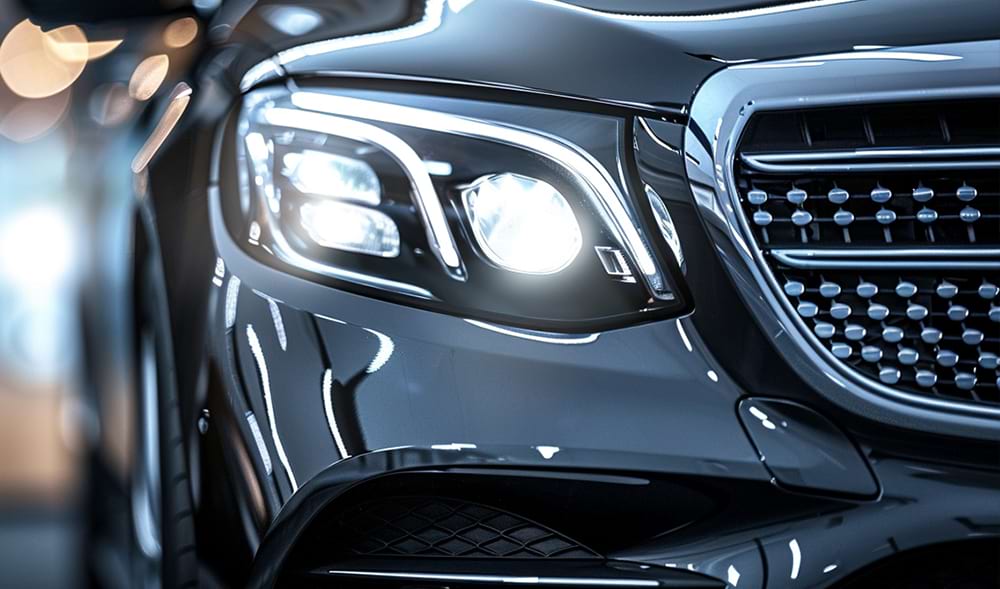
PMMA delivers remarkable optical advantages for modern vehicle designs. It reliably transmits up to 92 percent of visible light. Unlike polycarbonate, standard acrylic features inherent UV stability at the molecular level. It will not yellow over time from prolonged sun exposure. This native UV resistance entirely eliminates the need for expensive secondary hard coats.
However, PMMA possesses notable mechanical limitations limiting its exterior usage. It exhibits lower overall impact resistance due to its naturally brittle nature. It simply cannot withstand heavy stone strikes like PC. Additionally, it features a considerably lower thermal tolerance. High-heat environments near combustion engines can easily warp or melt delicate acrylic components.
These specific traits dictate highly optimal automotive applications. We strongly recommend PMMA for vehicle areas prioritizing aesthetics over brute strength.
Tail light lens assemblies and red rear reflectors.
Interior ambient lighting modules across the dashboard.
Complex light guide strips and halo rings.
For modern edge-lighting applications, achieving total internal reflection is critical. PMMA handles this optical requirement beautifully. It ensures highly uniform edge-illumination without annoying color shifting across the light band.
Comparing these polymers side-by-side simplifies the complex engineering decision. You must balance optical purity against vital physical toughness. We provide a straightforward evaluation matrix to guide your selection process.
Material Performance Comparison Matrix
Performance Attribute | Polycarbonate (PC) | PMMA (Acrylic) |
|---|---|---|
Optical Clarity | ~89% Light Transmission | >92% Light Transmission |
Impact Resistance | Extreme (Shatter-proof under load) | Moderate/Low (Prone to brittle failure) |
Thermal Stability | Excellent (HDT up to 130°C+) | Moderate (HDT ~90°C maximum) |
Scratch Resistance | Low native resistance (Requires coating) | Higher native resistance to micro-scratches |
Production Cost | Higher (Secondary UV coating mandatory) | Lower (Bypasses secondary coating steps) |
Production expenses highlight a major operational difference between the two plastics. PC requires significantly higher processing temperatures, consuming more factory energy. Furthermore, the mandatory coating operations add substantial cycle time and capital expense. Facilities must invest heavily in specialized dip-coating or flow-coating lines.
Conversely, PMMA remains generally more cost-effective from start to finish. It completely bypasses the secondary curing stages. This streamlined production path reduces labor overhead and minimizes scrap rates associated with coating defects.
Mastering PMMA and polycarbonate injection moulding demands deep technical expertise. These materials exhibit distinct processing behaviors inside the barrel. PC has a notoriously higher melt viscosity. It requires significantly higher melt temperatures and mold temperatures to flow properly into thin walls. In contrast, PMMA is highly sensitive to ambient moisture. You must execute meticulous pre-drying protocols for several hours to prevent cosmetic surface defects like splay.
Designing a robust automotive light lens mould is a critical engineering milestone. We emphasize the absolute necessity of integrating conformal cooling channels. Traditional straight-line cooling cannot manage thick optical geometries effectively. Proper conformal cooling prevents uneven warpage during the crucial curing phase. It also eliminates residual internal stress within the plastic part. Such stress causes birefringence, which severely distorts optical outputs and ruins projected beam patterns.
Surface finish requirements also heavily dictate your tooling budgets. You must secure an SPI A-1 mould finish (Grade #3 diamond buff) for all optical surfaces. This pristine, mirror-like finish is absolutely non-negotiable for external lenses. It prevents unwanted light scattering and guarantees strict DOT and ECE compliance. Maintaining this delicate finish over high-volume production runs remains an ongoing maintenance challenge for moldmakers. Frequent cleaning and specialized non-abrasive handling protocols are required on the factory floor.
Engineers often rely on a simple rule of thumb for exterior lighting parts. Forward-facing, impact-prone components always demand polycarbonate. Rear-facing components prioritizing maximum optical clarity lean heavily toward PMMA.
Next, evaluate the total unit cost for each module assembly. You must weigh PMMA’s lower raw material and streamlined processing costs. Compare them directly against PC’s mandatory secondary coating and UV curing processes. Sometimes, the added physical durability of PC easily justifies its higher manufacturing premium. Other times, over-engineering a simple tail light with PC simply wastes budget.
Finally, consider future-proofing your designs for advanced LEDs. Modern LED arrays become cooler and much more compact every single year. As operational thermal loads drop, PMMA becomes viable in entirely new interior spaces. We suggest evaluating if PMMA can replace PC in certain forward-lighting modules. Areas where heat was previously too extreme might now accommodate acrylic safely.
Ultimately, neither polymer is objectively better than the other. The correct material choice is strictly dictated by the component's physical location on the vehicle. You must balance specific optical benefits against mechanical trade-offs and safety regulations.
To ensure project success, consider these actionable steps moving forward:
Determine primary impact risks first to eliminate unsuitable materials early.
Factor in secondary coating expenses when calculating long-term production budgets.
Consult with injection molding experts during the earliest design phases.
Optimize part geometry to minimize internal stresses and avoid optical birefringence.
Validate your cooling layout using comprehensive mold flow analysis software.
By partnering with experienced toolmakers early, Tier 1 suppliers can avoid costly tooling rework. Specify the correct tool steel and cooling layout immediately to guarantee pristine optical components for years to come.
A: Polycarbonate headlights rely on a factory-applied, UV-resistant hard coat. UV radiation, abrasive road debris, and harsh wash chemicals slowly degrade this thin protective layer. Once the coating fails, the underlying raw polycarbonate is exposed to the sun. It rapidly oxidizes, resulting in the cloudy, yellow appearance commonly seen on older vehicles.
A: Generally, no. PMMA fails stringent pedestrian safety regulations because it easily shatters upon impact. It also lacks the physical durability to survive high-velocity road debris. However, manufacturers frequently use PMMA for internal optical components, such as the precision lenses positioned directly over LEDs inside the sealed headlight housing.
A: Base tooling costs remain relatively similar, as both polymers require an expensive SPI A-1 diamond buff finish. However, polycarbonate molds often command a slight premium. They require more robust tool steels and specialized gating systems to handle PC’s higher injection pressures and elevated processing temperatures safely.
A: PMMA is overwhelmingly preferred for light guide strips. It offers superior light transmission and exceptional total internal reflection (TIR) properties. This ensures vibrant, uniform edge-illumination across the entire strip. Unlike PC, PMMA manages this without causing unwanted color shifting or requiring secondary anti-yellowing treatments.


